 Join Now
 Sign Petition
 Tell Friends
Israel’s Hidden Ancient Facts: Kevin Bermeister on Israel’s indigenous record through the lens of Jerusalem, archaeology and emerging events.
Rebuilding Jerusalem’s Temple
Image Credits: Kevin Bermeister
On the Eastern slope of Mount Moriah on an upper ridge above Jerusalem’s Gihon Spring, archaeology leads to one striking conclusion: This location and its features confirm the recently re-discovered Matzevah as the stone Jacob anointed (Genesis 28:22) as his covenant at Beit El. Therefore, it marks the beacon that will ultimately identify the location of the altar for Israel’s third temple.
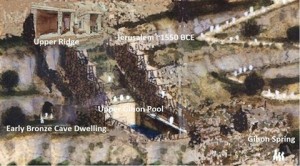
It has already been confirmed that features carved into the side of mount Moriah, immediately below the upper ridge, date back to the early bronze age. Further, that the ‘soft’ burial by one of the last kings of Israel, around 2600 years ago protected the high ridge for thousands of years until its recent discovery. Finally small idolatrous items discovered in the soft layers were remnants that do not disprove the bedrocks sanctity. The city wall built by the Emorites and Jebusites above the upper ridge would have prevented access to the upper ridge in the 210 years Israel was in Egypt.
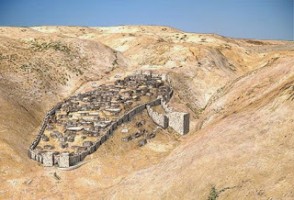
and city walls at the time of Joshua (~1300 BCE)
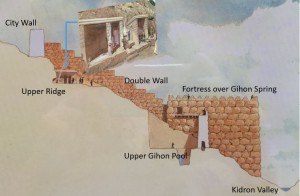
For 37 years the Ark of the Covenant was housed in the City of David, prior to Davids son King Solomon moving it to the temple he constructed a few hundred meters further up the mountain. Some think King David constructed on the upper ridge to temporarily locate the Ark of the Covenant, but that’s not supported in the archaeology. In any event, Iron age King David would not have erected a matzevah because that practice ceased with Israel’s forefathers around the Bronze age time of Jacob. Additionally the bedrock was chiseled using stone implements not iron, a sure sign of its Bronze age origin. Finally the matzevah must be naturally formed because it is thin, precisely honed and smoothed, well beyond the technology of that time.
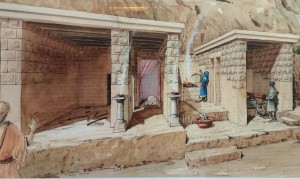
The impressive features of the upper ridge including, oil and grain press, vessel holders, small animal pen, liquids channel, animal processing area, matzevah and platform of the original altar are definitive signatures of holy worship. Based on small artifacts retrieved in soft layers, some archaeologists have opined it may have been used for unholy worship, but they misread the overwhelming holy character of the high ridge in context.
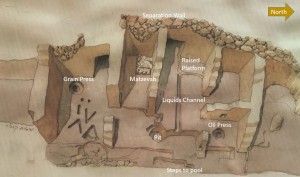
The upper ridge location on the neck of Mount Moriah contradicts mainstream Jewish custom that the correct place for the altar of the future temple will be on the top of the mountain. This issue can be resolved in a number of ways according to the character and stature of Jewish law and custom, but it will take time before it is accepted as its valid location by the authoritative leaders of Israel. Traditionally the neck of a mountain was always the location associated with the altar, but the first and second temple altar followed the location chosen by King David based on events of his life which opposed prevailing Jewish law.
As the excavation on the upper ridge nears completion the public will, for the first time in thousands of years be able to make decisions about this amazing discovery Exposing this phenomenon may just be the beginning of an impressive transformation.